
Mitchell County Dissolution of Marriage
Mitchell County dissolution of marriage records are kept at the District Clerk's office in Colorado City. If you need to search for a divorce case or get copies of a Final Decree of Divorce filed in Mitchell County, the District Clerk is the right place to start. The county has a small population and one district court that handles all family law matters. Records go back to 1876. You can visit the courthouse in person or contact the clerk's office by phone or mail to request what you need. The clerk handles all filings, case lookups, and copy requests for dissolution cases in this West Texas county.
Mitchell County Overview
Mitchell County District Clerk
The District Clerk in Colorado City keeps all dissolution of marriage records for Mitchell County. This office stores case files, handles copy requests, and can help you look up old or recent cases. If you need a certified copy of a Final Decree of Divorce, you get it from this office.
Mitchell County is part of the 32nd Judicial District. The district court handles family law cases including dissolution of marriage, custody, and support matters. The courthouse is in Colorado City on Oak Street. Staff can help you find case records by name or cause number.
| Office | Mitchell County District Clerk |
|---|---|
| Address | 400 Oak St. Colorado City, TX 79512 |
| Mailing | P.O. Box 1121, Colorado City, TX 79512 |
| Phone | (325) 728-3471 |
| Fax | (325) 728-8277 |
| Hours | Monday through Friday, 8:00 AM to 4:30 PM |
Filing and Accessing Dissolution Records
To file for dissolution of marriage in Mitchell County, at least one spouse must have lived in Texas for six months and in Mitchell County for at least 90 days. This comes from Texas Family Code Chapter 6. Once you meet the residency rule, you file the Original Petition for Divorce at the District Clerk's office.
Texas requires a 60-day waiting period after the petition is filed. Under Texas Family Code Section 6.702, the court cannot grant the divorce until 60 days have passed. Exceptions apply in cases with family violence. After the waiting period, the judge signs the Final Decree of Divorce, which wraps up the case.
To look up a dissolution case in Mitchell County, go to the courthouse in person. Bring the name of at least one party or a cause number if you have it. The clerk can search records going back to 1876. You can also use the statewide re:SearchTX portal to search for case information online at no cost.
You can request copies by mail. Write to the District Clerk at P.O. Box 1121, Colorado City, TX 79512. Include the case name, cause number if known, and a check for the copy fee. Certified copies cost more than plain ones. Call the office first to confirm current fees before you send payment.
Search Mitchell County Records Online
The Texas Office of Court Administration runs the re:SearchTX portal. This free tool lets you search for dissolution of marriage cases filed in Mitchell County and across the state. You can look up cases by party name or cause number and view case documents online.
Re:SearchTX provides unofficial copies of documents. These are fine for general research or to confirm case details. If you need a certified copy of the Final Decree of Divorce for legal purposes, you must get it from the Mitchell County District Clerk directly. Certified copies have an official stamp and signature that make them valid for things like name changes or remarriage.
The statewide eFile Texas system is used by attorneys to submit filings electronically. Pro se filers (people without lawyers) may also use it. For general case search, re:SearchTX is the better starting point.
Note: Not all older records appear on re:SearchTX. For cases filed before the system was set up, check with the Mitchell County District Clerk directly.
Vital Statistics and Divorce Verification
The Texas Department of State Health Services keeps a statewide index of divorce records going back to 1968. If you need to verify that a divorce took place in Texas but do not know the exact county, DSHS can help. Visit the DSHS Vital Statistics page to learn about the verification process.
DSHS provides a Texas Divorce Verification Letter. This letter confirms the divorce happened but does not contain full case details. For the actual court documents or a certified copy of the decree, you still need to go to the Mitchell County District Clerk. The DSHS verification letter is mainly used when you just need to show proof that a divorce occurred.
For divorces before 1968, DSHS does not have records. You need to contact the District Clerk in the county where the divorce was filed. In Mitchell County, records go back to 1876. Older records may require more time to locate.
The Texas vital records order system lets you request certain records online. For divorce verifications, check the DSHS site to see what is available and what you need to provide.
Texas Law and Dissolution of Marriage
Dissolution of marriage in Texas is governed by Texas Family Code Chapter 6. The main no-fault ground is insupportability. This means the marriage has broken down due to conflict and there is no chance it will work. You do not have to prove fault to get a divorce under Texas law.
Texas is a community property state. Property acquired during the marriage is generally community property. Under Texas Family Code Chapter 7, the court divides community property in a way it finds just and right. Separate property includes what each spouse owned before the marriage plus gifts and inheritances received during it.
If children are involved, the court makes orders for conservatorship and possession. Texas uses the term "managing conservator" rather than "custodian." The standard possession order sets the default schedule for the non-primary parent. The court looks at the best interest of the child when making these decisions.
You can find self-help guides and official court forms at Texas Court Help and TexasLawHelp.org. The Texas State Law Library at sll.texas.gov has research guides for people handling their own cases.
Legal Help in Mitchell County
Legal aid groups serve West Texas residents who cannot afford an attorney. These groups can help with dissolution of marriage cases, custody disputes, and related family law matters.
Texas RioGrande Legal Aid serves a wide region of West Texas and handles family law cases. Call (888) 988-9996 to ask about eligibility. Lone Star Legal Aid covers other parts of the state. The State Bar of Texas lawyer referral service is available at (800) 252-9690. You can also search for an attorney at texasbar.com.
Self-help resources include TexasLawHelp.org, which has free forms and guides in plain language. The Texas State Law Library provides research guides and can point you to the right statutes. Official court forms are also available at txcourts.gov.
The Texas Courts FAQ page answers common questions about how dissolution of marriage cases work in Texas, including residency rules and the 60-day waiting period.
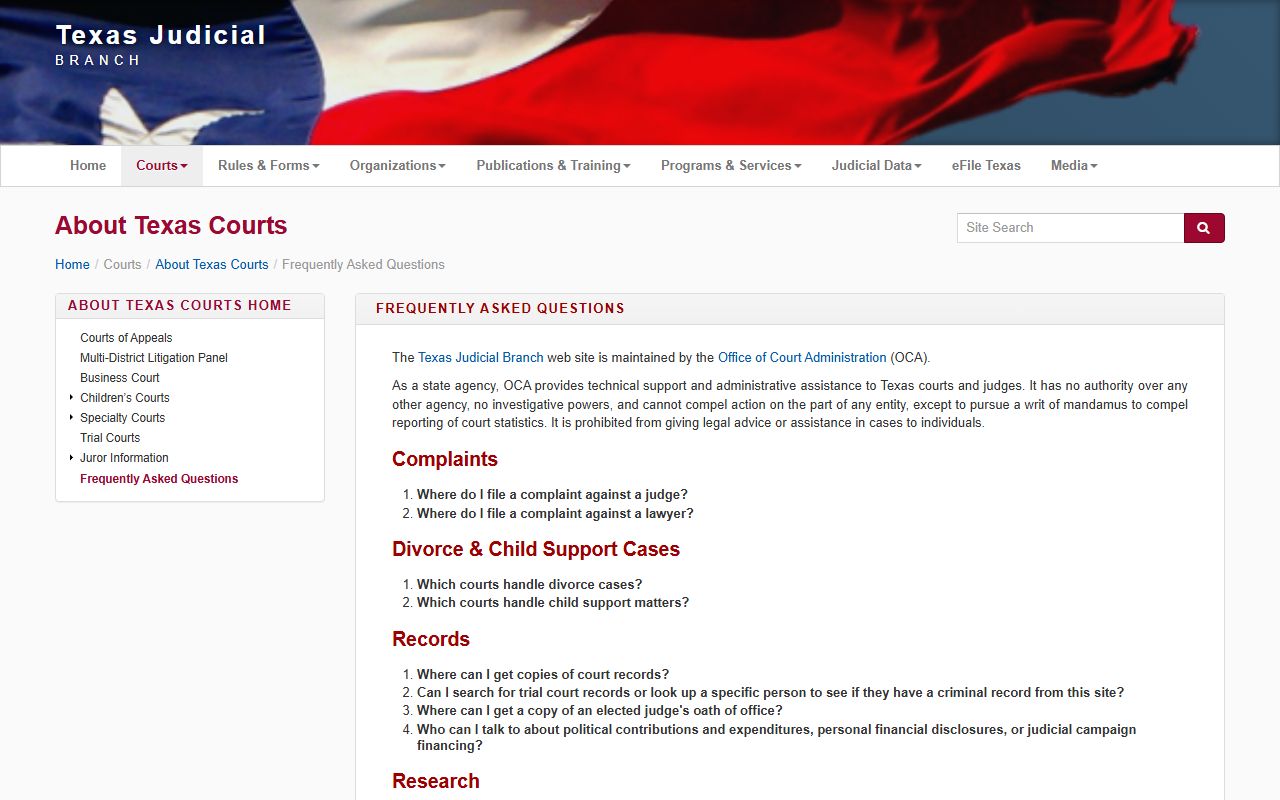
The FAQ covers everything from how to file to what happens after the judge signs the decree.
Cities in Mitchell County
Mitchell County's county seat is Colorado City. All dissolution of marriage cases filed by residents of this county go through the Mitchell County District Court. All cases in this county are handled at the District Clerk's office in Colorado City.
Nearby Counties
These counties border Mitchell County. Make sure you file in the right county based on where you live.