
Rusk County Dissolution of Marriage Records
Rusk County dissolution of marriage records are kept at the District Clerk's office in Henderson. If you need to look up a divorce case, check filing requirements, or get a certified copy of a final decree, the District Clerk handles all of that. The county covers a wide area in East Texas, and all divorce filings go through the district court system in Henderson. This guide covers how to search records, what you can expect to find, and where to get help.
Rusk County Overview
Rusk County District Clerk
The District Clerk in Henderson keeps all dissolution of marriage records for Rusk County. This office handles every step from the first filing to the final signed decree. Staff can search by name or cause number and provide copies of documents on file.
Rusk County is part of the 4th Judicial District of Texas. The courthouse is in Henderson, which is where you go to file, search records in person, or pick up certified copies. The District Clerk's office serves all residents of Rusk County, whether they live near Henderson or in the more rural parts of the county.
The Rusk County official website at co.rusk.tx.us has links to county offices and some basic court information. For records searches, the statewide re:SearchTX portal is another option if you know the case number or party names.
| Office | Rusk County District Clerk |
|---|---|
| Address | 115 N Main St Henderson, TX 75652 |
| Phone | (903) 657-0355 |
| Hours | Monday through Friday, 8:00 AM to 5:00 PM |
| Website | co.rusk.tx.us |
The Rusk County official site gives you a starting point for finding the right office and contact info. Here is a look at the county web portal:
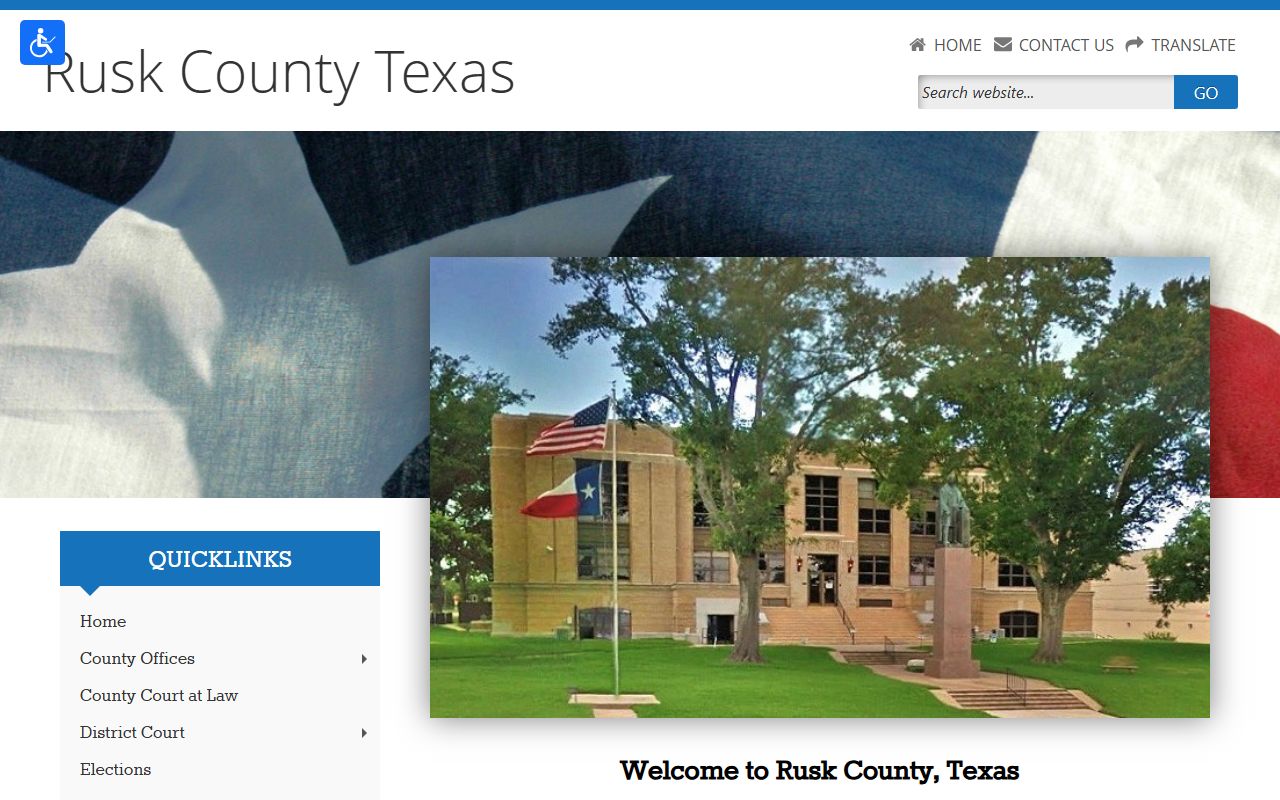
From there, you can navigate to the District Clerk and find out what documents they have on file and how to request them.
How to Search Rusk County Divorce Records
There are a few ways to look up dissolution of marriage records in Rusk County. Online searches work for basic case information. If you need the full file or a certified copy, you go in person to the courthouse in Henderson.
The statewide re:SearchTX system at re.search.txcourts.gov lets you search district court records by party name or cause number. Not every county uploads all documents, but most show party names, filing dates, and case status. Rusk County cases appear in this system. You can also try the Texas Court Records search portal shown below:
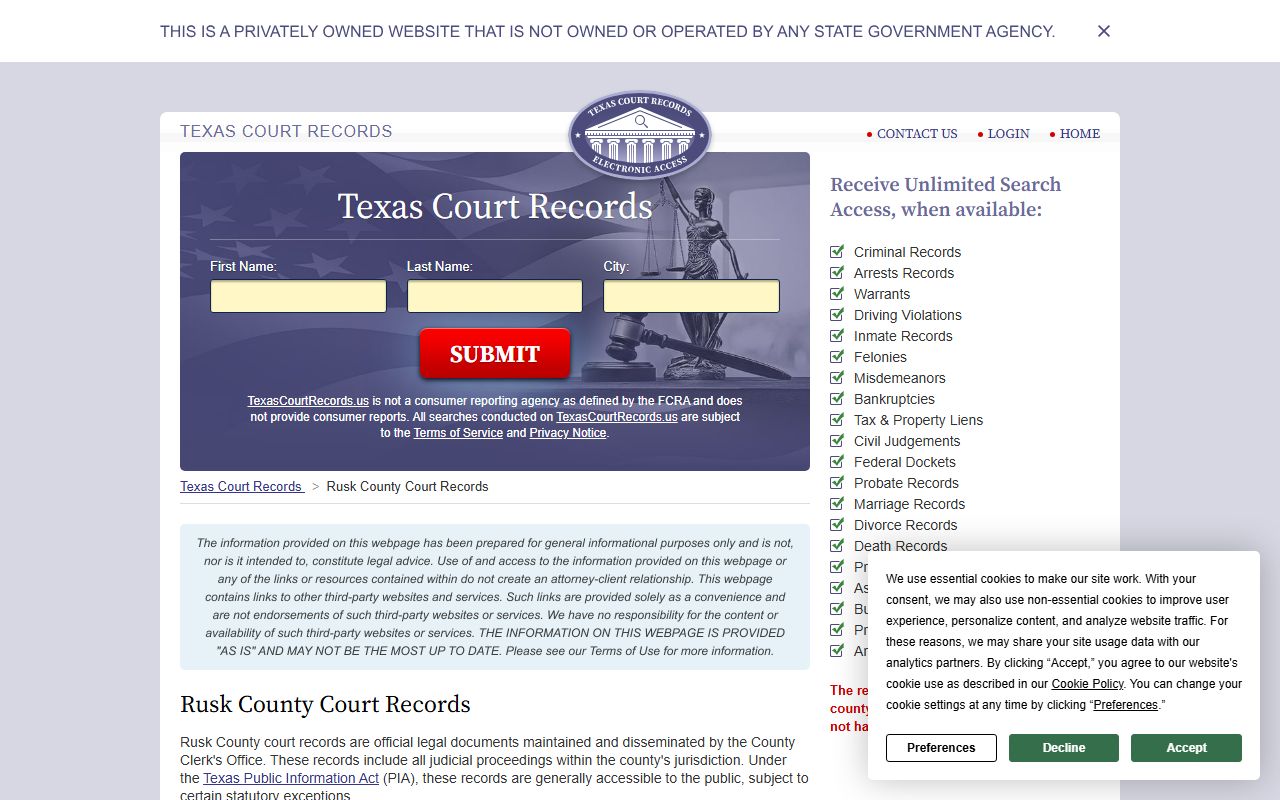
That portal gives you a secondary path to look up case data and check filing history without driving to Henderson.
For an in-person search, go to the District Clerk's office at 115 N Main St in Henderson. Bring the name of at least one party or the cause number if you have it. Staff will search their records system and can pull up cases going back many years. Copies are available right away, though certified copies take a bit longer to prepare. Bring a valid ID.
Note: Online case data may not include sealed documents or older paper-based records. For complete records, always confirm with the clerk's office directly.
Filing for Dissolution of Marriage in Rusk County
To file for divorce in Rusk County, you must meet the residency requirement under Texas Family Code Chapter 6. At least one spouse must have lived in Texas for six months and in Rusk County for at least 90 days before you can file here.
You start by filing an Original Petition for Divorce with the District Clerk. You pay the filing fee at the time you submit your papers. The other spouse must be served with a copy of the petition or must sign a Waiver of Service. Under Texas Family Code Section 6.702, there is a mandatory 60-day waiting period from the date the petition is filed before a judge can sign off on the final decree. Exceptions exist when family violence is involved.
If both spouses agree on all terms, they can file an Agreed Final Decree of Divorce. This is quicker. If they disagree on property, custody, or support, the case may go through mediation or end up at trial before the district judge. Texas uses community property rules for dividing assets under Texas Family Code Chapter 7. Property each spouse owned before the marriage, plus gifts and inheritances, is generally separate property and stays with the spouse who owns it.
Cases with children require additional steps. The court will set a conservatorship arrangement and a possession schedule under Texas Family Code Chapter 153. Child support is handled separately. Both parents may need to take a parenting class before the final decree is signed.
60-Day Wait: Texas law requires a 60-day waiting period after the petition is filed. The judge cannot sign the final decree until that period passes, except in cases involving family violence.
Rusk County Divorce Filing Fees
Filing fees in Rusk County are set by the District Clerk and include state-mandated surcharges. A typical dissolution of marriage filing without children runs around $300. Cases with children may cost a bit more. These fees cover court facility charges, record archiving, and other required costs.
Other costs you may run into include service of process fees (if the constable or a process server delivers papers to the other party), fees for certified copies of the final decree, and any costs tied to mediation if the case is contested. If children are involved, a parenting class is usually required and comes with its own cost.
If you cannot afford the filing fee, you can ask the court to waive it. File a Statement of Inability to Afford Payment of Court Costs with your petition. Forms are available at the courthouse and online at txcourts.gov. The court reviews your financial situation and decides whether to grant the waiver.
Note: Fees can change. Call the Rusk County District Clerk at (903) 657-0355 to confirm current amounts before you go in to file.
What Rusk County Dissolution Records Contain
When you ask for a dissolution of marriage record in Rusk County, you are usually asking for the court file. That file holds all the documents filed in the case. The most important one is the Final Decree of Divorce, which is the court order that ends the marriage and spells out all the terms.
Other documents in the file typically include the Original Petition for Divorce, the citation served on the respondent or a signed waiver, any temporary orders issued during the case, financial disclosures, and agreements on property or custody. If the case went to trial, you may also find hearing transcripts and exhibits.
Divorce records in Rusk County are generally public. You do not have to be a party to the case to request copies. That said, some information may be restricted. Records tied to minors, sealed financial documents, and protective order details may not be open to general inspection. Ask the clerk what is available if you are unsure.
Certified copies of the Final Decree of Divorce are needed for legal purposes like changing your name, updating a passport, or proving marital status. The District Clerk issues these for a per-page fee. Plain copies cost less but may not be accepted in all situations.
Legal Help in Rusk County
Getting a divorce can be complicated. If you need help in Rusk County, a few organizations serve the East Texas region. Some offer free or low-cost help for people who qualify based on income.
Lone Star Legal Aid serves the East Texas area including Rusk County. They handle family law cases, including dissolution of marriage, for people with limited income. Visit lonestarlegal.org or call (800) 733-8394 to ask about eligibility. The Texas RioGrande Legal Aid and Lone Star programs cover different parts of Texas, so make sure you contact the right one for East Texas.
The State Bar of Texas has a lawyer referral service at (800) 252-9690 and online at texasbar.com. This can help you find a local attorney in Henderson or the surrounding area. TexasLawHelp at texaslawhelp.org provides self-help guides and free court forms for divorce cases. Official forms are also available at txcourts.gov.
The Texas State Law Library at sll.texas.gov has free legal resources online, including the full text of the Texas Family Code. If you want to understand what the law says before you talk to an attorney, that is a good place to start.
Nearby Counties
These counties border or sit near Rusk County. If you are not sure which county holds your records, the address where you lived at the time of filing is the key factor.