
Find Dissolution Of Marriage Records in Grand Prairie
Grand Prairie dissolution of marriage records are held by the district clerk of whichever county you live in. Grand Prairie is unusual because the city spans three counties: Dallas, Tarrant, and a small portion of Ellis. Most residents fall in Dallas or Tarrant County. Where you file, and where records are kept, depends on which county your home address is in. You can search for dissolution cases using the re:SearchTX statewide portal or through each county's own online records system. Certified copies and full case files are available from the relevant District Clerk's office in person or by mail.
Grand Prairie Overview
Which County Handles Your Case
Grand Prairie spans Dallas County, Tarrant County, and a small portion of Ellis County. Before you file for dissolution of marriage, you need to know which county your home is in. That determines where you file and which District Clerk's office holds your records. Most Grand Prairie addresses fall in Dallas County or Tarrant County.
If your address is in the Dallas County portion of Grand Prairie, you file at the Dallas County District Court and the Dallas County District Clerk holds your records. If your address is in the Tarrant County portion, you file in Fort Worth at the Tarrant County District Court. Contact info for both offices is below.
| Dallas County District Clerk | 600 Commerce St, Dallas, TX 75202 Phone: (214) 653-6076 dallascounty.org |
|---|---|
| Tarrant County District Clerk | 100 N Calhoun St, Fort Worth, TX 76196 Phone: (817) 884-1265 tarrantcounty.com |
| Ellis County District Clerk | Waxahachie, TX (small portion only) |
Note: Check your county by looking at your official mail or the county appraisal district website. Most Grand Prairie residents file in Dallas County.
Search Grand Prairie Dissolution Records
The best starting point for most Grand Prairie residents is the re:SearchTX statewide portal. It covers district courts in all 254 Texas counties. You can search by party name or cause number without knowing which county handled the case. The system returns case details, docket entries, and current status.
You can also search each county's own system. Dallas County has an online records portal through the Dallas County records search. Tarrant County has its own case lookup system as well. Both are searchable by party name. Once you find the case, contact the relevant District Clerk to request copies or full file access.
For older records not in online systems, you may need to contact the courthouse directly. Staff can search by name or cause number and let you know what's available and how to get it.
Dissolution Filing Requirements
Grand Prairie residents follow Texas Family Code Chapter 6 just like all other Texas residents. The residency requirement under Texas Family Code Section 6.301 says one spouse must have lived in Texas for six months and in the filing county for at least 90 days before the petition is filed.
The most common ground for dissolution is insupportability under Texas Family Code Section 6.001. This no-fault ground requires no proof that either spouse did something wrong. It just means the marriage has broken down due to conflict or discord with no reasonable chance of repair. Fault-based grounds also exist, including cruelty, adultery, and abandonment, but most cases use the no-fault approach.
Texas law requires a 60-day waiting period after the Original Petition for Divorce is filed. The court cannot grant the dissolution until that period has passed. Once both spouses agree on all terms, or after a trial, the judge signs the Final Decree of Divorce. That decree is the document you need for name changes and other legal purposes. Copies are available through the District Clerk of the county where the case was filed.
Grand Prairie spans three counties. Verify your county of residence before filing to make sure you go to the correct courthouse and meet the 90-day county residency requirement.
Using re:SearchTX for Grand Prairie Cases
The re:SearchTX portal is especially useful for Grand Prairie because you can search across multiple counties at once. Since cases could be in Dallas, Tarrant, or Ellis County, the statewide system lets you find the right record without guessing which county to check first. The portal is free and publicly accessible.
Search results show the party names, county, case type, and filing date. From there, you know exactly which District Clerk to contact for certified copies or full file access. The portal does not provide downloadable documents, but it confirms where the case is held and what happened in the proceedings.
Texas DSHS Divorce Verification
The Texas DSHS Vital Statistics Unit maintains a statewide index of divorces granted in Texas from 1968 to the present. If you need to confirm that a divorce happened and get basic details, a DSHS divorce verification letter is an option. The fee is $20. This is not the same as a certified copy of the Final Decree. To get the actual decree, contact the District Clerk in the county where the divorce was filed.
The Texas DSHS Vital Statistics Unit provides divorce verification records going back to 1968 for cases filed across the state, including Grand Prairie.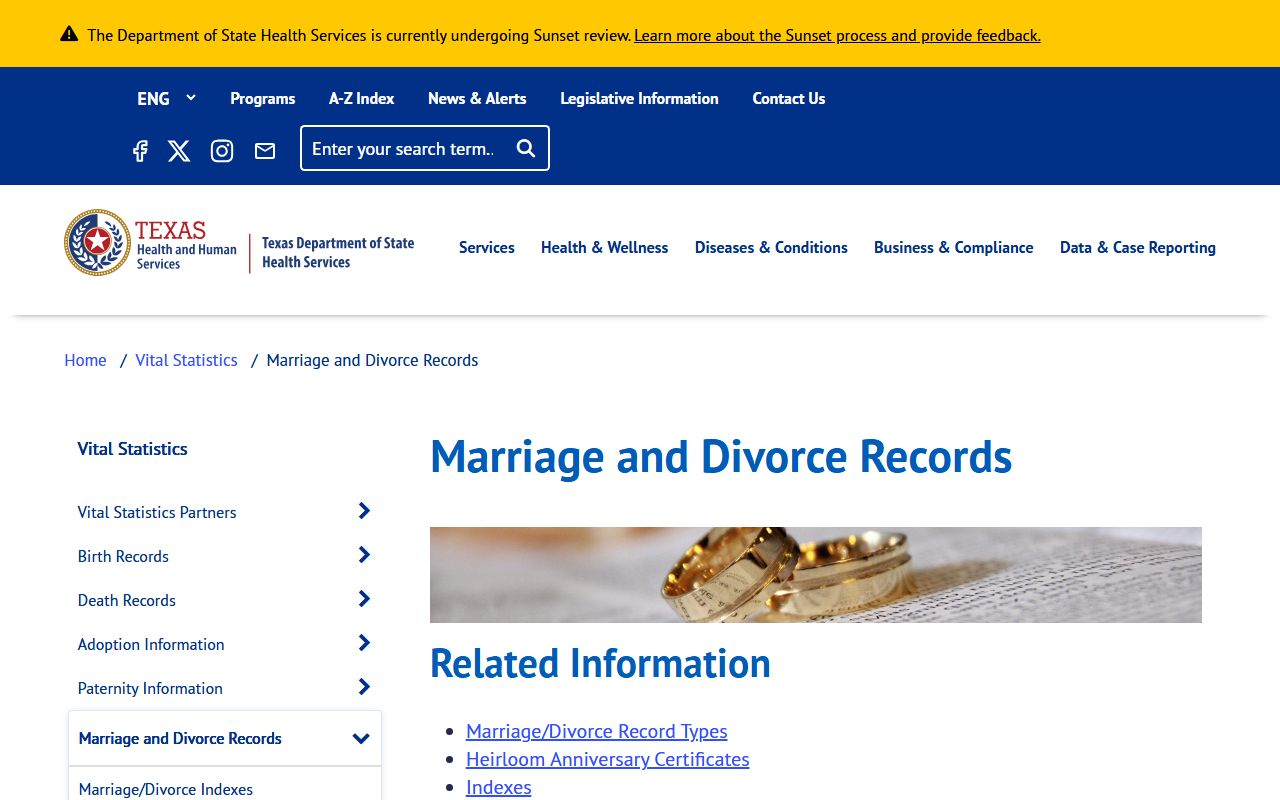
A DSHS divorce verification letter confirms the record of a dissolution and can be used for administrative purposes like name changes or remarriage applications when a full certified copy is not needed.
Legal Help in Grand Prairie
Legal Aid of Northwest Texas serves all three counties that include Grand Prairie. They handle family law cases for people who qualify based on income. The Dallas Bar Association at (214) 220-7444 and the Tarrant County Bar Association at (817) 336-4101 both offer lawyer referral services.
TexasLawHelp.org has self-help guides and forms for people handling their own dissolution case. Official court forms are available at txcourts.gov. You can also file electronically through eFile Texas. The Texas Court Help site has plain-language guides for each step of the process. The Texas State Law Library offers free legal research tools online to all Texas residents.
The City of Grand Prairie's official website provides local government services and community resources for residents navigating city-related matters.
Grand Prairie's city government does not handle dissolution records, but the city website can help you confirm which county your address falls in, which is the first step toward finding the right courthouse.
Nearby Cities
Other qualifying cities near Grand Prairie where dissolution records are maintained by county district clerks:
- Arlington - Tarrant County
- Irving - Dallas County
- Dallas - Dallas County
- Fort Worth - Tarrant County
- Mesquite - Dallas County
Dallas County Dissolution Records
Most Grand Prairie residents are in Dallas County. All dissolution filings for that portion go through the Dallas County District Court. For more on the Dallas County court system and records access, visit the Dallas County dissolution records page.