
Victoria County Dissolution Of Marriage
Victoria County dissolution of marriage records are filed and kept at the District Clerk's office in Victoria, Texas. You can search cases by name or cause number to find filings, decrees, and other court documents. The District Clerk handles all family law filings in the county, including divorce cases going back many years. If you need a certified copy of a final decree or just want to check the status of a case, the District Clerk is the right place to start. This page explains how to search, request copies, and find legal help in Victoria County.
Victoria County Overview
Victoria County District Clerk
The District Clerk's office in Victoria handles all dissolution of marriage filings for the county. Staff can help you look up cases, get copies of documents, and process records requests. The office is on the third floor of the courthouse at 115 North Bridge Street in Victoria.
Victoria County falls within the 24th Judicial District. The district court handles all family law matters, including dissolution of marriage cases, custody disputes, and support orders. If you or your spouse lives in Victoria County, you file your case here. The courthouse is in downtown Victoria near other county offices.
| Office | Victoria County District Clerk |
|---|---|
| Address |
115 N Bridge Street, 3rd Floor Victoria, TX 77901 |
| Phone | (361) 575-0581 |
| Hours | Monday through Friday, 8:00 AM to 5:00 PM |
The County Clerk's office is also in the same building at Suite 103 and can be reached at (361) 575-1478. The County Clerk handles vital records, including marriage licenses. For dissolution of marriage case files and certified copies of decrees, go to the District Clerk on the third floor.
Search Victoria County Divorce Records
You have a few ways to search for dissolution of marriage records in Victoria County. The quickest way is to use the statewide re:SearchTX portal, which lets you look up cases by party name or cause number at no cost. This system covers many Texas counties and shows basic case data, party names, and docket entries.
In-person searches at the District Clerk's office give you full access to the case file. Bring the name of one or both parties, the approximate year the case was filed, or the cause number if you have it. Staff can search the system and pull up case records. You will need a valid ID to get certified copies. Plain copies cost $1.00 per page. Certification adds $5.00 per document.
For a simple proof of divorce, you can also order a divorce verification letter from the Texas Department of State Health Services. The DSHS vital statistics office keeps divorce records from 1968 onward. A verification letter costs $20.00. It shows that a divorce occurred but does not include full case details.
What you need to search:
- Full name of one or both spouses
- Year the case was filed (helpful but not required)
- Cause number (if available)
- Valid ID for certified copies
Note: Some older records may not be in the online system. Call the District Clerk's office before making a trip if you are looking for records from before 1990.
Filing for Dissolution of Marriage in Victoria County
To file for dissolution of marriage in Victoria County, you must meet the residency rules set by Texas Family Code Chapter 6. At least one spouse must have lived in Texas for six months and in Victoria County for 90 days before filing. These rules apply no matter where the marriage took place.
You start by filing an Original Petition for Divorce at the District Clerk's office. The filing fee covers court costs and various mandatory surcharges. After that, the other spouse must be served or must sign a Waiver of Service. Texas law also requires a 60-day waiting period before the court can sign a final decree. Under Texas Family Code section 6.702, this waiting period begins on the day the petition is filed. There is an exception if family violence is involved.
Most people in Victoria County file on no-fault grounds. The legal term for this is insupportability under Texas Family Code section 6.001. It means the marriage can no longer work because of conflict with no real hope of fixing things. You do not need to prove fault to get a divorce in Texas. Fault grounds like cruelty, adultery, or abandonment are also allowed but are less common.
If both spouses agree on all terms, an agreed divorce moves faster. The judge reviews the agreement and signs the Final Decree of Divorce once the waiting period ends. Contested cases may go to mediation or trial. The District Clerk keeps all these documents as part of the public court record.
Waiting Period: Texas requires a 60-day wait after filing before a final decree can be signed. Plan your timeline around this requirement when you file.
What Victoria County Marriage Dissolution Records Include
A dissolution of marriage case file in Victoria County contains all documents filed during the case. The Original Petition for Divorce starts the file. The Citation shows the other spouse was served. If both parties agree, a Settlement Agreement or Mediated Settlement Agreement will be in the file as well. Financial affidavits, temporary orders, and other motions may also be included.
The Final Decree of Divorce is the most important document. It is the court order that ends the marriage. The decree spells out property division under Texas Family Code Chapter 7, any conservatorship or possession orders for children, child support amounts, and spousal maintenance if the court ordered it. You will need a certified copy of the decree to change your name or show proof of divorce to a government agency or employer.
Most dissolution of marriage records in Victoria County are public. Anyone can request them. Some parts of a case may be sealed, such as detailed financial documents or records involving minor children. The District Clerk can tell you what is available for the case you are looking for.
re:SearchTX for Victoria County Cases
The Texas Office of Court Administration runs re:SearchTX, a statewide portal for court records. You can search Victoria County dissolution of marriage cases by name, cause number, or date range. The system is free to use and does not require an account for basic searches.
re:SearchTX shows party names, filing dates, case status, and docket entries. You can see what documents have been filed and when. Full document viewing may require a registered account or a fee depending on the record type. For certified copies, you still need to go through the Victoria County District Clerk. The online system is best for checking case status and finding cause numbers before you make a trip to the courthouse.
The Texas Courts website also has guides and forms at txcourts.gov. You can find official divorce forms, standing orders, and information about the filing process there.
Divorce Verification Through DSHS
The Texas Department of State Health Services keeps statewide divorce records from 1968 to the present. You can order a divorce verification letter through the Texas vital records online portal or by mail. The fee is $20.00 per verification. Expedited processing costs an additional $10.00.
A DSHS verification letter confirms that a divorce was granted and shows the county where it was filed and the year. It does not include full decree details. If you need the actual terms of the divorce or a certified copy of the decree, you must contact the Victoria County District Clerk directly. For many official purposes like passport applications or remarriage, the verification letter is enough.
The screenshot below shows the DSHS vital statistics page where you can order divorce verification records for Victoria County and all other Texas counties.
The Texas DSHS vital statistics office maintains a searchable database of marriage and divorce records going back decades.
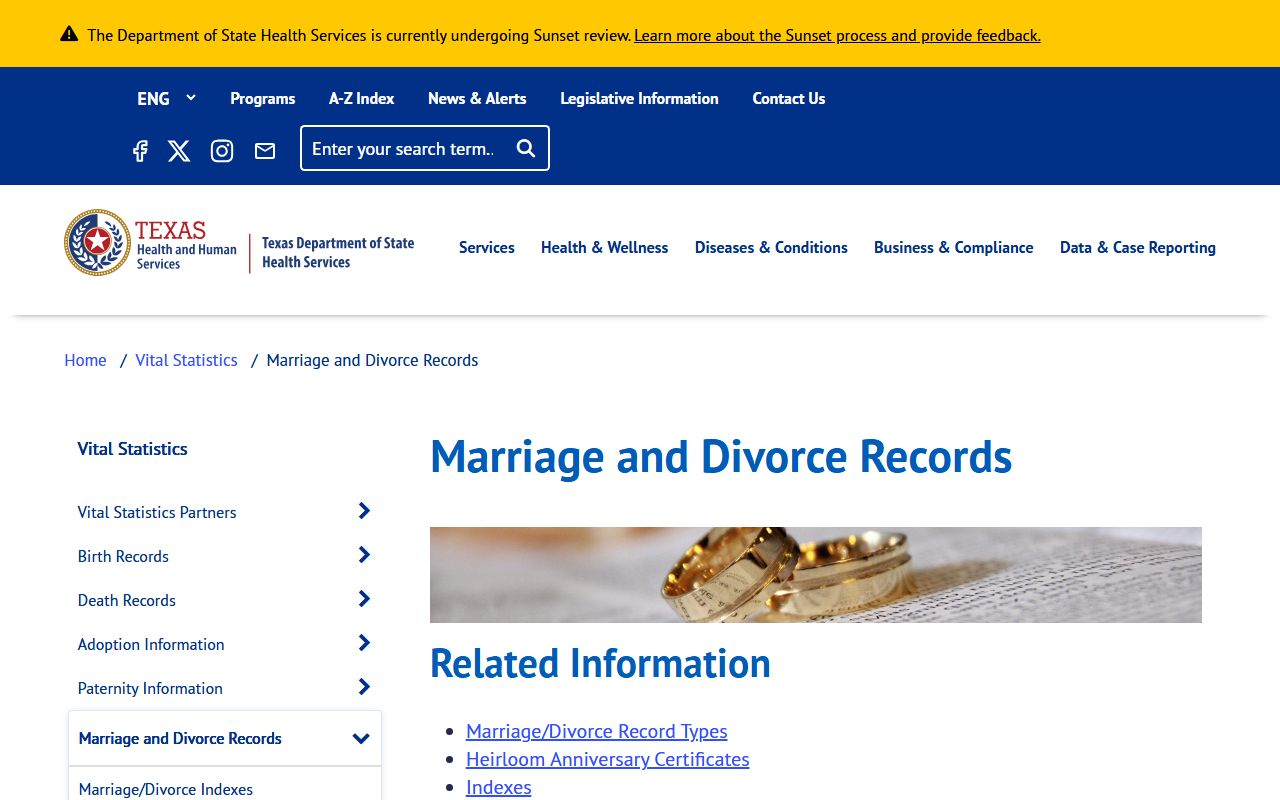
Use the DSHS portal to order a $20 verification letter confirming a Victoria County dissolution of marriage.
Legal Help in Victoria County
If you need help with a dissolution of marriage case in Victoria County, several resources are available. The Texas Court Help website at texascourthelp.gov has guides on how to file for divorce without a lawyer, what forms to use, and what to expect at each step. It is run by the Texas courts and the content is reliable.
Texas Law Help at texaslawhelp.org provides free legal information and self-help forms for divorce, custody, and support cases. The site has county-specific guides and plain-language instructions. This is a good resource if you plan to handle your own case. It does not give legal advice, but it gives solid information.
Lone Star Legal Aid serves counties in South Texas and the Gulf Coast region. They handle family law cases for people who meet income guidelines. Call their main line or visit lonestarlegal.org to check eligibility. The State Bar of Texas also has a lawyer referral service at (800) 252-9690 if you need to find a local attorney. The Texas State Law Library at sll.texas.gov has research tools and guides for self-represented litigants.
Note: The District Clerk's office cannot give legal advice. They can only help with filing and records. Contact legal aid or a private attorney for case guidance.
Cities in Victoria County
Victoria County includes the city of Victoria along with several smaller communities. All dissolution of marriage cases in the county go through the Victoria County District Court.
Communities in Victoria County include Victoria, Bloomington, Inez, Placedo, and others. Residents of all these areas file at the District Clerk's office at 115 North Bridge Street in Victoria.
Nearby Counties
Victoria County borders several other Texas counties. If you are not sure which county you should file in, check your current address. You must file in the county where you or your spouse has lived for at least 90 days.