
Crosby County Divorce Records
Crosby County dissolution of marriage records are on file at the District Clerk's office in Crosbyton, the county seat. Located on the South Plains of West Texas, Crosby County is a rural county where the 72nd District Court handles all family law matters. If you need to look up a divorce case, request a certified copy of a final decree, or find information about a past filing, contact the District Clerk in Crosbyton directly. The office handles in-person and mail requests on regular business days.
Crosby County Overview
Crosby County District Clerk
The Crosby County District Clerk keeps all dissolution of marriage records for the county. The 72nd Judicial District Court serves this area. All divorce petitions, orders, decrees, and supporting documents go into the case file at the District Clerk's office. The clerk is also the person to contact for certified copies of final decrees.
Crosbyton is a small farming community and county seat. The courthouse is where all county records are kept. Mail requests are a practical option for people who do not live nearby. Include the names of the parties, the year of filing if you know it, and a check or money order for the copy fees.
| Office | Crosby County District Clerk |
|---|---|
| Address |
Crosby County Courthouse P.O. Box 218 Crosbyton, TX 79322 |
| Phone | (806) 675-2334 |
| Hours | Monday through Friday, 8:00 AM to 5:00 PM |
| Website | co.crosby.tx.us |
The official Crosby County website at co.crosby.tx.us has contact information for county offices.
The Crosby County official site provides contact details and links to local offices handling dissolution of marriage filings.
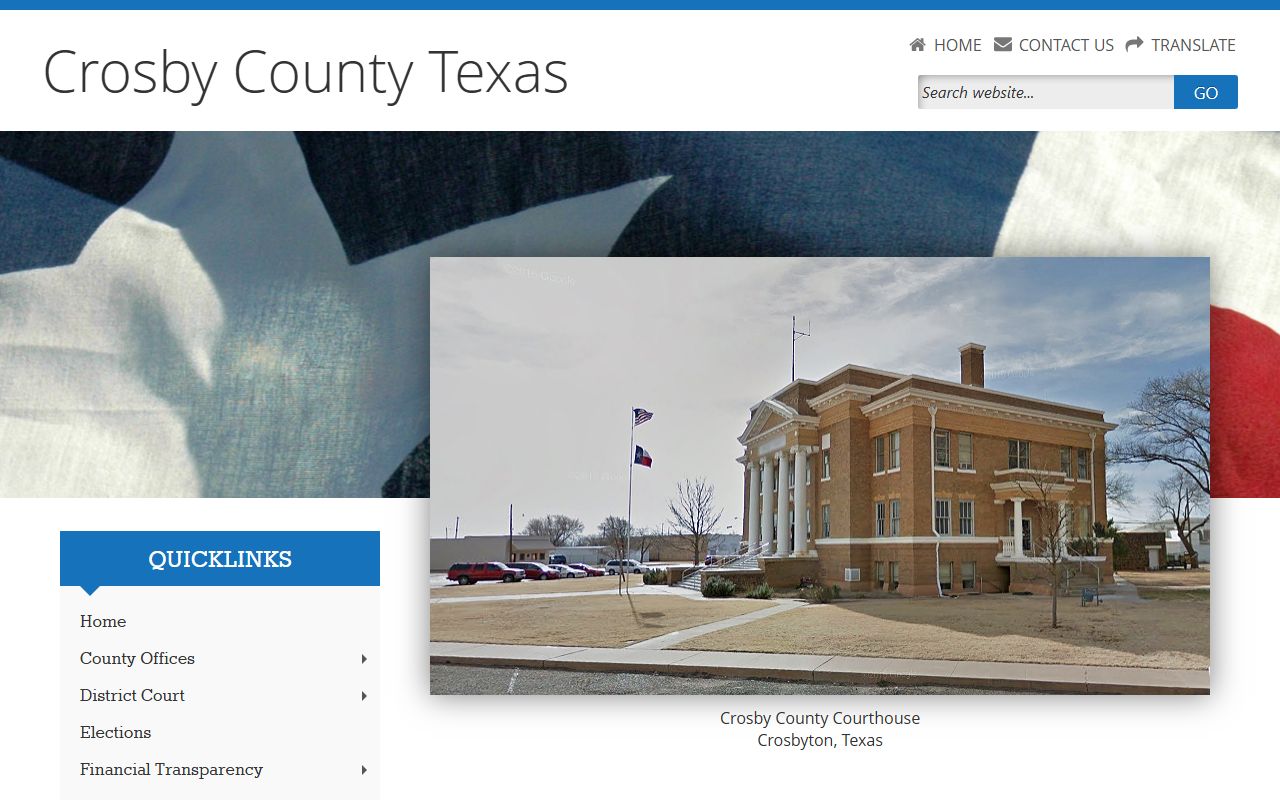
Check the site before your visit to confirm hours and any special procedures for requesting records.
Searching Dissolution of Marriage Records in Crosby County
Crosby County does not maintain its own public online search portal. To find dissolution records, contact the District Clerk by phone at (806) 675-2334 or submit a mail request. You can also try the statewide re:SearchTX portal, which includes records from participating Texas district courts. Coverage for smaller rural counties may be limited.
Have the full name of at least one party and the approximate year of filing ready when you call or write. A cause number speeds things up considerably if you have it. Copies are $1 per page. Certification adds $5 per document. For mail requests, include a self-addressed stamped envelope and payment by check or money order payable to the Crosby County District Clerk.
Attorneys and self-represented parties can file new divorce cases through eFile Texas. E-filing is mandatory for attorneys in Texas. All documents filed through the system are stored as part of the official case file at the District Clerk's office.
Filing for Divorce in Crosby County
Divorce filings in Crosby County follow Texas Family Code Chapter 6. One spouse must have lived in Texas for six months and in Crosby County for at least 90 days before the petition can be filed. Once those requirements are met, the petitioner files the original petition with the District Clerk and it gets assigned to the 72nd District Court.
The most common ground is insupportability under Texas Family Code Section 6.001. This is a no-fault ground that says the marriage cannot continue because of ongoing conflict with no reasonable expectation of working things out. It does not require proving anyone was at fault. Fault grounds like cruelty, adultery, abandonment, felony conviction, or three-year separation are also available under the same chapter.
Texas requires a 60-day waiting period after the petition is filed before the court can grant a divorce. This comes from Texas Family Code Section 6.702. The respondent must be served with the petition or file a written waiver of service. If both parties agree on all terms, the case can move quickly after the waiting period. Contested cases take longer and may need hearings or mediation.
Property is divided under Texas Family Code Chapter 7 in a just and right manner. Community property includes most things acquired during the marriage. Separate property, meaning what each person owned before the marriage or inherited, stays with that person. Spousal maintenance is addressed under Texas Family Code Chapter 8. It is not automatic and requires meeting specific legal criteria.
Crosby County Divorce Records Contents
Dissolution of marriage files in Crosby County typically include the original petition for divorce, any temporary orders, property agreements or financial statements, and the final decree. Cases with children also have conservatorship orders, a parenting plan or possession schedule, and support orders. All of these documents are part of the public court file once the case is closed.
The Final Decree of Divorce is the main document. It ends the marriage legally and sets out all terms. Certified copies are required for name changes, proving your marital status, and many government or legal purposes. Plain copies cost less and work for personal use.
Most divorce records are public under the Texas Public Information Act. Financial details like account numbers and Social Security numbers are typically redacted. State-level divorce verification from Texas DSHS Vital Statistics covers divorces since 1968 and costs $20 per search. It confirms the record exists but is not a certified copy of the decree.
Legal Help for Crosby County Residents
If you need a family law attorney, the State Bar of Texas referral service at (800) 252-9690 can help. Search for local or regional attorneys at texasbar.com. Attorneys from Lubbock, which is close to Crosby County, often handle cases in the area.
Free self-help resources are available at TexasLawHelp.org. Legal Aid of Northwest Texas serves this region and may assist income-qualified residents with family law matters. Official Texas court forms are at txcourts.gov, and the Texas State Law Library has free legal research resources.
Cities in Crosby County
Crosbyton is the county seat and largest community in Crosby County. All dissolution of marriage cases go through the District Clerk in Crosbyton.
Nearby Counties
These counties border Crosby County on the South Plains. File in the county where you have lived for at least 90 days.