
Lubbock County Divorce Records
Lubbock County dissolution of marriage records are on file at the District Clerk's office in downtown Lubbock. You can search for cases online or visit the courthouse in person to request documents. The District Clerk handles all divorce and family law filings for the county, and records go back to 1876. Whether you need to look up an active case or get a certified copy of a final decree, the District Clerk is where you start.
Lubbock County Overview
Lubbock County District Clerk
The District Clerk's office in Lubbock keeps all dissolution of marriage records for the county. The office handles filings, stores case files, and provides certified and plain copies of court documents. Staff can help you search by party name or cause number. The office is on the ground floor of the courthouse on Broadway in downtown Lubbock.
Lubbock County is the regional hub for West Texas. The city of Lubbock has a population of over 263,000, making it the 10th largest city in Texas. The county is home to Texas Tech University and a large healthcare sector. Divorce cases here range from simple agreed decrees to complex contested matters involving property, children, and spousal support. The county has several family district courts to handle the volume of cases filed each year.
You can reach the District Clerk by phone or email. The office runs a case search system online. Contact details and online access are listed at co.lubbock.tx.us.
| Office | Lubbock County District Clerk |
|---|---|
| Address | 904 Broadway, Ste. 101 Lubbock, TX 79401 |
| Mailing Address | P.O. Box 10536, Lubbock, TX 79408 |
| Phone | (806) 775-1040 |
| Fax | (806) 775-1029 |
| districtclerk@co.lubbock.tx.us | |
| Hours | Monday through Friday, 8:00 AM to 5:00 PM |
The Lubbock County official website provides information on county offices, court resources, and how to access dissolution of marriage records filed with the District Clerk.

Lubbock County's courthouse on Broadway is home to the District Clerk, which maintains all family court records including divorce and dissolution of marriage filings dating back to 1876.
How to Search Lubbock County Dissolution Records
Lubbock County has an online case search system where you can look up dissolution of marriage cases by party name or cause number. The system shows basic case data, docket entries, and current status. Go to the county's website at co.lubbock.tx.us to find the link. You can also search through the statewide re:SearchTX portal, which covers many Texas district courts in one place.
To search by name, you need at least one party's full legal name. A year helps narrow things down. A cause number gives you direct access to the case. If you only have a partial name, the system may still return results, but you will need to sort through them. In-person searches at the courthouse are also an option. Staff can pull up cases and let you review the index.
Certified copies of a final decree require a visit to the courthouse or a written mail request. You will pay a per-page fee plus a certification charge. Bring your ID or include a copy with your mail request. The clerk does not send copies without payment, so confirm the amount before you send anything.
Note: Online access shows case information but not full document scans. For the actual documents, you need to visit or mail a request to the District Clerk's office.
The statewide court records portal covers Lubbock County dissolution of marriage filings and lets you search cases online by party name or cause number.
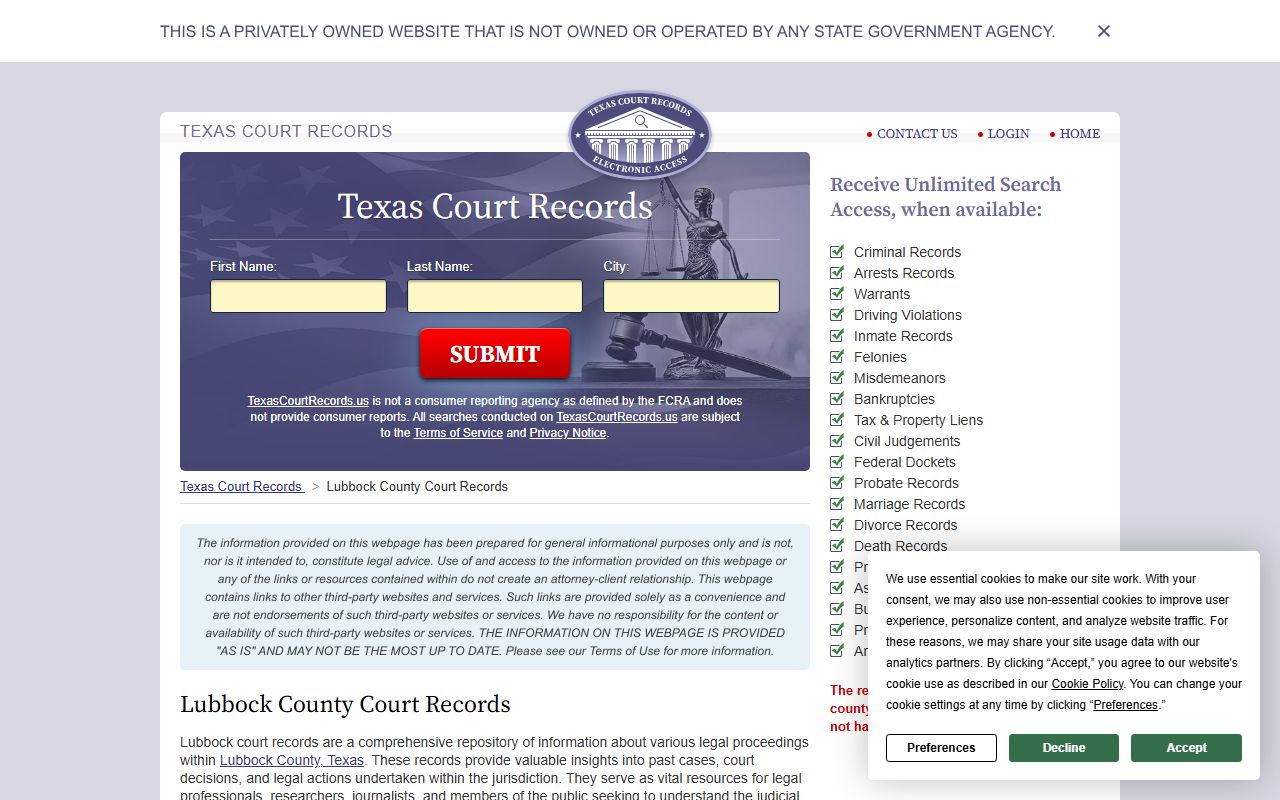
Using a public records portal can help you locate Lubbock County divorce filings quickly before following up with the District Clerk for official copies.
How to File for Divorce in Lubbock County
Texas law governs all dissolution of marriage cases in Lubbock County. Under Texas Family Code Chapter 6, one spouse must have lived in Texas for at least six months and in Lubbock County for at least 90 days before filing. You file the Original Petition for Divorce with the District Clerk and pay the filing fee at that time.
The other spouse must be served with the petition and citation or sign a waiver of service. Texas allows no-fault divorce under Section 6.001, which uses the ground of insupportability. This means the marriage can no longer work due to conflict or personality differences with no hope of reconciliation. You don't have to prove anyone did anything wrong to use this ground.
After filing, there is a mandatory 60-day waiting period before the judge can sign a final decree. If both parties agree on all terms, the case can often be wrapped up quickly after that wait. Contested cases take longer and may go through mediation or a court hearing. Child-related matters follow Texas Family Code Chapter 153, which lays out how courts handle conservatorship and access.
60-Day Waiting Period: Texas requires at least 60 days from the date the petition is filed before a court can finalize a divorce. There are limited exceptions for family violence situations.
Property division in Lubbock County follows community property rules set out in Texas Family Code Chapter 7. The court divides marital property in a way that is just and right. Assets and debts gained during the marriage are considered community property. Separate property, such as what a spouse owned before marriage or received as a gift, stays with that spouse.
What Lubbock County Divorce Records Contain
Dissolution of marriage records in Lubbock County are made up of everything filed in the case from start to finish. The original petition starts the file. Then come service documents, any agreements, financial disclosures, and any temporary orders the court issued while the case was pending. The final decree ends the file and is the document most people want copies of.
The Final Decree of Divorce is a detailed court order. It sets out who gets each piece of property, how debts are split, any spousal maintenance terms, and if children are part of the case, the full conservatorship and child support arrangement. Certified copies of this decree are needed when you want to change your name, refinance property, or show proof of your marital status.
Most Lubbock County divorce records are public. You don't need to be a party to the case to view them or get copies. Some financial source documents like tax returns may be sealed by the court. Information about minor children, especially detailed possession schedules or evaluations, may have restricted access in some cases.
Fees for Lubbock County Dissolution of Marriage
Filing fees in Lubbock County run in the range of $275 to $325 for a standard divorce case without children. Cases that involve minor children are typically a bit higher. These fees include various statutory surcharges for the court facility, law library, and other mandated costs. The exact amount can change, so always confirm with the clerk before filing.
Other costs to plan for include service of process, which runs $50 to $100 depending on whether you use the constable or a private process server. Certified copies of the final decree cost per page plus a certification fee. If you need multiple certified copies, those add up quickly.
Fee waivers are available for people who cannot afford to pay. You file a Statement of Inability to Afford Payment of Court Costs. This is a sworn statement about your income, expenses, and assets. The court reviews it and decides whether you qualify for a waiver or reduced fee. Forms are on the Texas Courts website at txcourts.gov.
Legal Resources in Lubbock County
Several organizations can help Lubbock County residents with dissolution of marriage cases. Legal Aid of Northwest Texas serves the Lubbock area and provides free legal help to people who meet income guidelines. Family law is one of their practice areas. You can reach them through their website or by calling their Lubbock office.
The Lubbock Area Bar Association has a lawyer referral service for people who need help finding an attorney. For broader searches, the State Bar of Texas offers a referral service at (800) 252-9690 or online at texasbar.com. A paid consultation with a family law attorney can help you understand what to expect and avoid costly mistakes.
If you want to handle the process on your own, texaslawhelp.org has plain-language guides and free forms for all types of family law cases. The Texas Court Help website at texascourthelp.gov walks you through the filing process step by step. All official court forms are also available at txcourts.gov.
Nearby Counties
These counties border or sit close to Lubbock County. You must file for dissolution of marriage in the county where you or your spouse has lived for at least 90 days.